
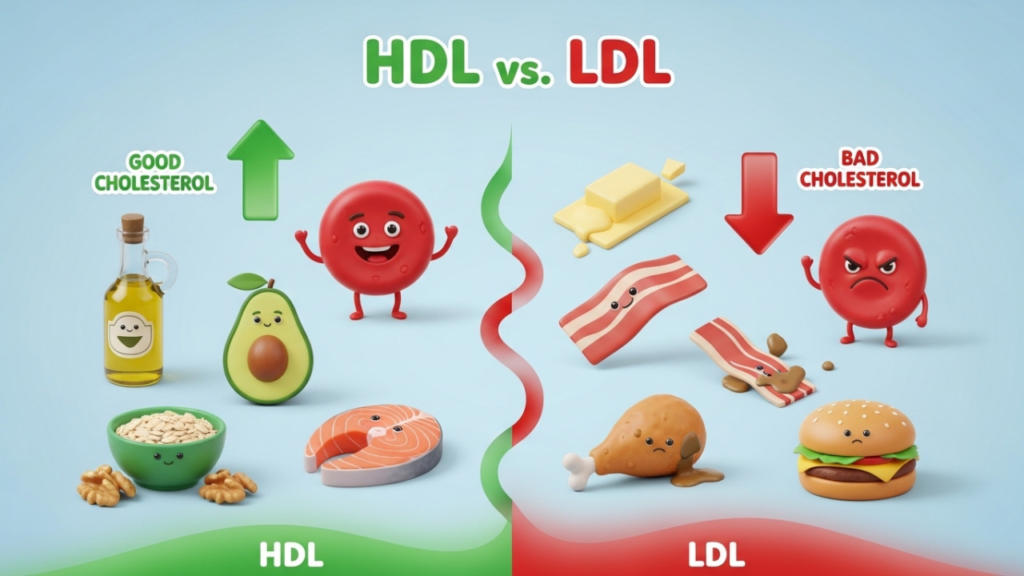
Cholesterol has been painted as the enemy of good health for decades. The messaging has been consistent: cholesterol is dangerous, high cholesterol is a crisis, and the goal is to drive it as low as possible.
The reality is more nuanced and more interesting than that.
What cholesterol actually is?
Cholesterol is a waxy, fat-like substance that your body produces and uses for essential functions. Every cell membrane in your body contains cholesterol. Without it, cells could not maintain their structure or communicate properly with each other. Your body uses cholesterol to make hormones, including estrogen, testosterone, cortisol, and aldosterone. It uses it to produce bile acids that digest fat. And it helps your body make Vitamin D when your skin is exposed to sunlight.
Your liver produces most of the cholesterol in your body, roughly 75 to 80%, regardless of how much you eat. The remaining 20 to 25% comes from food. This is why dietary cholesterol has a smaller effect on blood cholesterol levels than was once believed.
Cholesterol is not inherently harmful. The problem is context: where it is, what form it is in, and what else is happening in your bloodstream at the same time.
Why your body needs cholesterol?
Cell membranes are composed partly of cholesterol, which provides the right amount of fluidity to function properly. Too little cholesterol and cell membranes become too rigid, affecting how well cells absorb nutrients, eliminate waste, and communicate with each other.
Steroid hormones are synthesized from cholesterol. This includes sex hormones (estrogen, progesterone, testosterone), stress hormones (cortisol), and hormones that regulate blood pressure and salt balance (aldosterone). Without adequate cholesterol, your body cannot produce these hormones at the levels your physiology requires.
Bile acids, made from cholesterol in the liver, are released into the small intestine to help digest dietary fat and fat-soluble vitamins (A, D, E, K). The brain is particularly cholesterol-dependent. Roughly 25% of the body’s total cholesterol is found in the brain, where it is critical for the formation and maintenance of synapses, the connections between neurons.
Where cholesterol comes from?
Your liver continuously makes cholesterol, adjusting production based on how much is coming in from your diet. When dietary cholesterol intake rises, the liver compensates by producing somewhat less. When dietary intake falls, the liver produces more.
This regulatory system means that eating more dietary cholesterol does not automatically raise blood cholesterol levels by the same amount. Roughly a third of people are “hyper-responders” who show significant changes in blood cholesterol levels in response to dietary cholesterol. The rest show relatively modest changes.
The distinction between dietary cholesterol and dietary saturated fat matters enormously because these two things are often confused. Saturated fat has a stronger effect on raising LDL cholesterol than dietary cholesterol itself for most people.
What HDL and LDL actually are?
Here is the key misunderstanding that almost everyone has: HDL and LDL are not types of cholesterol. They are transport vehicles that carry cholesterol through the bloodstream.
Cholesterol is a fat-soluble molecule. Blood is water-based. Fat and water do not mix, so cholesterol cannot travel through the bloodstream on its own. The liver packages cholesterol into protein-coated particles called lipoproteins (lipo meaning fat, protein meaning the protein coating). These lipoproteins carry cholesterol through the bloodstream to wherever it is needed.
LDL (Low-Density Lipoprotein) carries cholesterol from the liver out to cells throughout the body. It delivers cholesterol where it is needed for cell membrane construction, hormone production, and other functions. The “bad” reputation stems from the fact that when LDL levels are high, excess LDL particles can accumulate in arterial walls, contributing to plaque buildup.
HDL (High-Density Lipoprotein) carries cholesterol from cells and artery walls back to the liver for recycling or elimination. This is why it is called “good” cholesterol. Higher HDL levels are associated with lower cardiovascular risk because HDL does the cleanup work.
The simplified version of “LDL bad, HDL good” is not wrong as a starting point. But it is an oversimplification that misses important nuance.
Why is LDL more complicated than “bad cholesterol”?
Not all LDL is equally dangerous. The risk associated with LDL depends heavily on particle size and whether the cholesterol it carries has been oxidized.
Small, dense LDL particles are more dangerous than large, fluffy LDL particles. Small dense LDL particles are small enough to slip through the gaps in arterial walls more easily and are also more prone to oxidation. Research consistently shows that the pattern of predominantly small, dense LDL carries significantly higher cardiovascular risk than the same LDL level in larger particles.
Oxidized LDL is the particularly dangerous form. When LDL particles are oxidized by free radicals, they trigger a more aggressive inflammatory response in artery walls, accelerating plaque formation. Oxidized LDL is considered a more accurate predictor of cardiovascular risk than total LDL in some research.
LDL particle number (LDL-P) is increasingly considered more important than LDL cholesterol concentration (LDL-C) by cardiovascular specialists. Two people can have the same LDL-C level but very different numbers of LDL particles, and particle number appears to be the stronger predictor of risk.
The numbers that matter most
Total cholesterol is less useful in isolation than is often presented. A high total cholesterol driven by very high HDL may carry less risk than the same number driven by high LDL and low HDL.
LDL cholesterol is generally the primary treatment target. Current guidelines from the American College of Cardiology suggest targets vary depending on individual cardiovascular risk level rather than applying a single threshold to everyone.
HDL cholesterol: Men should aim for above 40 mg/dL, women above 50 mg/dL. Higher is generally better, with levels above 60 mg/dL considered protective.
Triglycerides: Ideally below 150 mg/dL. High triglycerides (above 200 mg/dL) are independently associated with cardiovascular risk.
Total cholesterol-to-HDL ratio: A ratio below 4:1 is generally considered favorable. Below 3.5:1 is ideal.
Triglycerides: the forgotten piece
Triglycerides are fats in the bloodstream that come from excess calories that the body has converted for storage. High triglycerides are an independent cardiovascular risk factor. They are also strongly linked to metabolic syndrome, insulin resistance, and type 2 diabetes.
The foods that raise triglycerides the most are excess refined carbohydrates, added sugar, and alcohol, not dietary fat, as commonly assumed. This is why some people see their triglycerides improve dramatically when they reduce their intake of sugar and refined carbohydrates, even without major changes in fat intake.
When cholesterol becomes a problem
Elevated LDL cholesterol becomes a cardiovascular risk factor primarily when it combines with other conditions: high levels of oxidative stress (which oxidizes LDL particles), chronic inflammation in artery walls, high blood pressure, high blood glucose and insulin resistance (which promotes both LDL oxidation and arterial inflammation), smoking, and family history of early cardiovascular disease.
For a young, non-smoking person with low blood pressure, no inflammation markers, and no metabolic dysfunction, a moderately elevated LDL carries far less absolute risk than the same LDL level in someone with multiple additional risk factors. This is why cardiovascular risk is always assessed as a combination of factors, not any single number.
What actually moves the needle?
The most meaningful lifestyle interventions for cholesterol management are covered in detail in Blog C2 on foods that lower LDL and Blog C5 on non-medication approaches. The short version: replacing saturated fat with unsaturated fat consistently lowers LDL. Increasing soluble fiber intake significantly lowers LDL. Regular aerobic exercise raises HDL. Reducing added sugar and refined carbohydrates lowers triglycerides and raises HDL. Not smoking improves the entire lipid profile.
Frequently Asked Questions (FAQs)
Very low total cholesterol (below 150 mg/dL) has been associated with increased risk of hemorrhagic stroke and depression in some research, though causality is not established. For most people, getting cholesterol “too low” from diet and lifestyle is not a realistic concern.
The original limits on dietary cholesterol were based on studies that did not adequately separate dietary cholesterol from saturated fat. When the two were separated, dietary cholesterol’s effect on blood cholesterol was found to be much smaller than thought. Eggs were removed from dietary restriction lists in the 2015 USDA Dietary Guidelines.
Statins have a well-established safety profile and strong evidence for reducing cardiovascular events in people at elevated risk. Side effects include muscle pain in some users and should be discussed with a doctor.
Yes, significantly. Familial hypercholesterolemia affects roughly 1 in 250 people and causes very high LDL from birth. People with this condition often need medication regardless of diet. Even without a formal diagnosis, genetics accounts for a substantial portion of individual cholesterol variation.
Yes. Chronic psychological stress raises cortisol levels, which stimulates the liver to produce more cholesterol. Stress management has a genuine, measurable effect on lipid profiles over time.
The Bottom Line
Cholesterol is not your enemy. It is a substance your body cannot live without, and the goal of good nutrition is to maintain a healthy balance, not to eliminate it. Understanding the difference between LDL and HDL, knowing that particle size matters as much as total numbers, and recognizing that triglycerides matter too gives you a much more useful picture of your cardiovascular health than the old “cholesterol is bad” message ever did.